 | |  | |  | |  | |  |
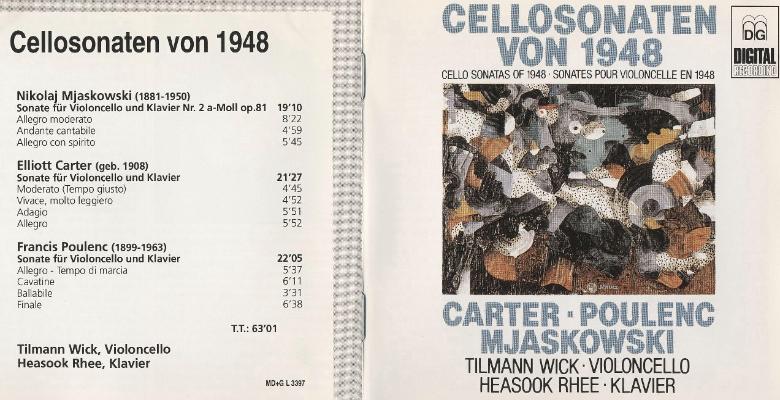
| Fanfare July/August 1992 CELLO SONATAS OF 1948. Tilmann Wick, cello; Heasook Rhee, piano. MD+G L3397[DDD]; 63:01. Produced by Werner Dabringhaus and Reimund Grimm. (Distributed by Koch International.) MIASKOVSKY: Sonata No.2 in A minor, op.81. CARTER: Sonata for Cello and Piano. Poulenc: Sonata for Cello and Piano If one wants to assemble a CD-ful of high quality, wide-ranging big works for cello with piano, it seems all one need do is find a vintage year and set to work. Here are three sonatas whose main thrusts are, respectively, gentle nostalgia, vaulting heroism, and sheer lyrical exuberance. That’s as wide a range as I can imagine sifting out a single year in this century; mull over with the cello repertoire and see what you can come up with! The pleasant surprise is the capacity with which Wick and Rhee take on this demanding task, producing performances of strong profile, fine focus on detail and color, and accurate aim at central character. Best work in this splendid lot is lavished upon Elliott Carter’s big sinewy sonata, more commonly treated in high –contrast, low-gradation monochrome, but here always bright and exuberant, with rhythmic organization completely under control. MD+G may ordinarily be depended upon to make chamber-music record of unexceptionable balance and body; they have done so once again. Strongly recommended! John Wiser American Record Guide July/August 1992 Cello Sonatas of 1948 by Miaskovsky (No.2); Carter; Poulenc Tilmann wick; Heasook Rhee, p MD+G 3397 (Koch International) 63 minutes This kind of programming appeals to me and offers a launching-pad for a lecture on postwar styles, which I shall try to keep to a dull roar. Nikolai Miaskovsky, trying to stay alive in Stalinist Russia, writes a warm but bitter brew for Rostropovich to play in an autumnal romantic style like a dream of distant beauty. Elliott Carter, in a relieved but disillusioned America, moves from Coplandesque simplicity on to new frontiers in metric modulation and towards the increased alienation between players that he was to develop further in the series of quartets he began two years later. Poulenc tries to help overcome the debility of post-war France by recalling a happier past with a vigor that tends to become vehement. All of these major works which Wick and Rhee play with passion and understanding, underlying the stylistic differences with a smooth, mellow tone for Miaskovsky but laying into Carter with a linear power and a fearless gutsy punch. Both here and in the volatile Poulenc, the cellist’s attacks and pizzicatos tend to have a disturbing amount of snap off the fingerboard, an effect used sparingly by Carter and I think never by Poulenc. Otherwise, these are excellent performances of some fine music. D. MOORE STEREO Juni 1992 CELLOSONATEN VON 1948 Werke von Mjaskowski, Carter und Poulenc Tilmann Wick (Violoncello), Heasook Rhee (Klavier) MD+G/Helikon L3397 CD, Spieldauer 63’01” DDD The performance of the three sonatas by Tilmann Wick and the Korean pianist Heasook Rhee who lives in New York, is powerfully capturing, colourful and graceful; Carter’s metric finess and rhythmic drive, Miaskovsky’s ardent longing and melancholic reflection, and Poulenc’s theatrical gesture and opulent diversity. The duo impresses with their sensitive musical congeniality and the technical supremacy. Das Entstehungsjahr 1948 ist den drei Cellosonaten gemeisam, kompositorisch trennen sie Welten. seinen ersten Streichquartett von 1951 zur ureigensten seinen ersten Streichquartett von 1951 zur ureigensten Sprache wurde, war neben den Möglichkeiten der Zeitstruktuerierung während der Komposition der Cellosonate entstanden. Cellosonate entstanden. Die romantische russische Kammermusiktradition beschwörte Nikolaj Mjaskowski (1881-1950), einstiger Vorkämpfer der Avantgarde, in seiner Sonate. Weitgesponnene Kantilenen, sanfter Lyrismus bestimmen das Werk, einen Nachruf auf vergangene Zeiten. Ironisch, verspielt, empfindsam, im Idion des französischen Neoklassizismus, ist Francis Poulencs Stück, das er mit der Bertung von Pierre Fournier geschrieben hatte. Zupackend, farbig und anmutig spielen Tilmann Wick und die koreanische, in New York lebende Pianistin Heasook Rhee die drei Sonaten: Carters metrische Rafinessen und rhythmischen Drive, Mjaskowskis sehnsuchtsvolle, melancholischen Gestus und Abwechslungsreichtum. Das Duo beeindruckt durch die feinfühlige musikalishce Übereinstimmung und die spieltechnische Souveränität. Hubert Böhm Die Ernte eines Jahres: 9 Musik: 9 Klantechnik: 9 |